Abstract
In the digital exchange of information, PDF (Portable Document Format) has become a standard owing to its cross-platform visual fidelity. However, this fixed layout also poses significant challenges for translation. Whether for product manuals, academic papers, or legal contracts, translating PDFs is often accompanied by difficulties such as text extraction issues, formatting disruptions, and even corrupted content. This article provides an in-depth analysis of the underlying causes of these challenges and introduces how next-generation AI solutions, represented by Shangyi AI (商译 AI), fundamentally address the problem of layout retention in PDF translation.
The Core Challenges of PDF Translation: Bridging the Gap Between 'What You See' and 'What You Get'
To effectively address the complexities of PDF translation, it is imperative to first understand the fundamental characteristics of the format. PDF was invented by Adobe with the primary aim of ensuring absolute consistency in visual presentation across all devices, rather than providing flexibility for content editing. It may be regarded as a digital 'snapshot' that precisely preserves the print layout. For more information, please refer to the official introduction to the PDF format or the relevant encyclopedia entry.
This design gives rise to several major challenges in the translation process:
- Discontinuity of text streams: In PDFs, text is often stored as independent character blocks positioned at precise coordinates, rather than as the continuous textual flow to which we are accustomed. As a result, direct copying or extraction is highly susceptible to sequence errors, word concatenation, or character corruption.
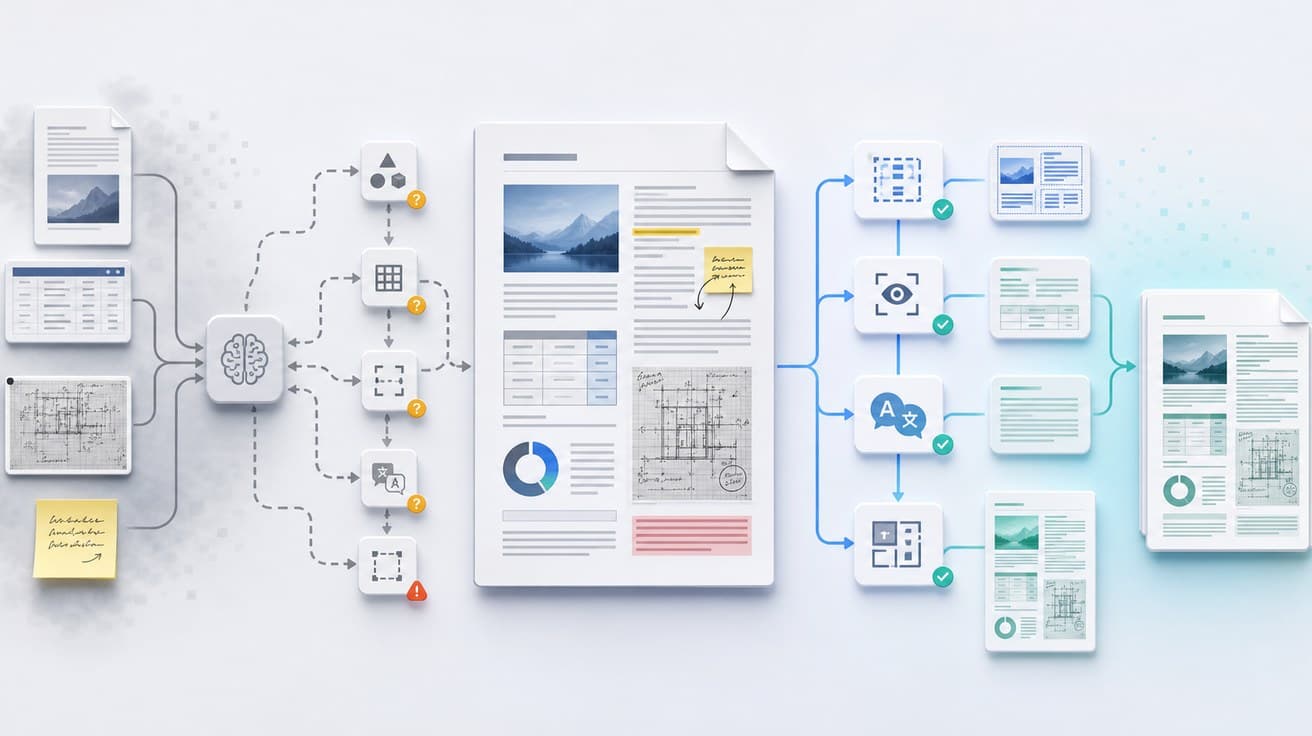
- Separation of content and layout: The document's layout and styles (such as tables, images, and fonts) are stored and rendered independently from the textual content. Traditional translation tools only crudely replace the text layer, lacking the capability to interpret and reconstruct complex typographical relationships, which leads to a complete collapse of document formatting.
- OCR Barriers in Scanned Documents: Scanned PDFs are fundamentally image files. Prior to translation, it is essential to convert them into machine-readable text using Optical Character Recognition (OCR) technology. The accuracy of this intermediate recognition step directly determines the quality of the final translation.
Shangyi AI: A New AI Translation Paradigm Based on Layout Reconstruction
To address these challenges, a new generation of AI-driven translation solutions has emerged. Shangyi AI (商译 AI) is a professional tool dedicated to this field. We have a thorough understanding of the challenges inherent in PDF translation: its core technology now extends beyond simple 'text replacement' to encompass intelligent layout analysis and reconstruction.
The Shangyi AI (商译 AI) engine is capable of intelligently analyzing the complex structure of PDF documents, accurately distinguishing among the content layer, image layer, and formatting layer. While delivering high-quality neural network translation, it is able to reconstruct the original layout with near pixel-level precision, ensuring the accurate positioning of text, images, tables, and even vector graphics.
This 'what you see is what you get' translation experience fundamentally addresses the format challenges inherent to traditional tools. The underlying principles of the translation technology represent a major advance in document processing.
Professional Strategies for Enhancing PDF Translation Quality and Efficiency
Combining mastery of advanced tools with a professional workflow can significantly increase translation productivity and quality.
1. Developing and Implementing a Glossary
Consistency in terminology translation is critical when processing specialized documents such as technical manuals, legal contracts, and academic reports. Utilizing the glossary function, you can predefine standardized translations for brand names, industry-specific terms, and proper nouns. Professional tools such as Shangyi AI rigorously adhere to these standards during translation, ensuring the professionalism and accuracy of the final output.
2. Emphasis on Localization and Cultural Adaptation
Translation is not merely a linguistic conversion, but also an adjustment to cultural context. A professional translation should align with the cultural conventions of the target market, such as appropriate date formats, currency units, and correct conversion of measurement systems. At times, a term may possess entirely different connotations in another cultural context. Attention to such details is critical for achieving the standards of 'faithfulness, expressiveness, and elegance' in translation.
3. Prioritize Editable Source Files
Although PDF translation technology has advanced considerably, obtaining original source files—such as Word (.docx), Excel (.xlsx), or PowerPoint (.pptx)—for translation, whenever possible, remains the most effective means of ensuring zero formatting loss. Understanding the translation strategies for various document types enables you to select the optimal solution for specific scenarios, significantly enhancing work efficiency.
Conclusion: Technological Empowerment to Overcome PDF Translation Barriers
PDF formatting barriers were once a primary obstacle in internationalized document workflows. With the development of intelligent parsing and layout reconstruction technologies represented by Shangyi AI, accurately preserving layouts during PDF translation has become a reality. This allows professionals to eliminate time-consuming post-translation layout adjustments and concentrate their efforts on high-value tasks such as content review and optimization.
> Visit the official Shangyi AI website to experience AI-powered document translation that retains the original formatting.