
For scholars, graduate students, and researchers, efficiently reading foreign-language literature lies at the core of daily work. However, translating an academic research paper PDF into one's native language poses challenges far surpassing those encountered in routine text translation.
The challenge extends beyond mere accuracy; the preservation of original formatting is paramount. A translation with disordered layout or separated figures and text is virtually unreadable. To identify tools that can truly fulfill research requirements, it is essential first to delineate the fundamental pain points of academic paper translation.
Core Challenges (Pain Points) in Academic Paper Translation
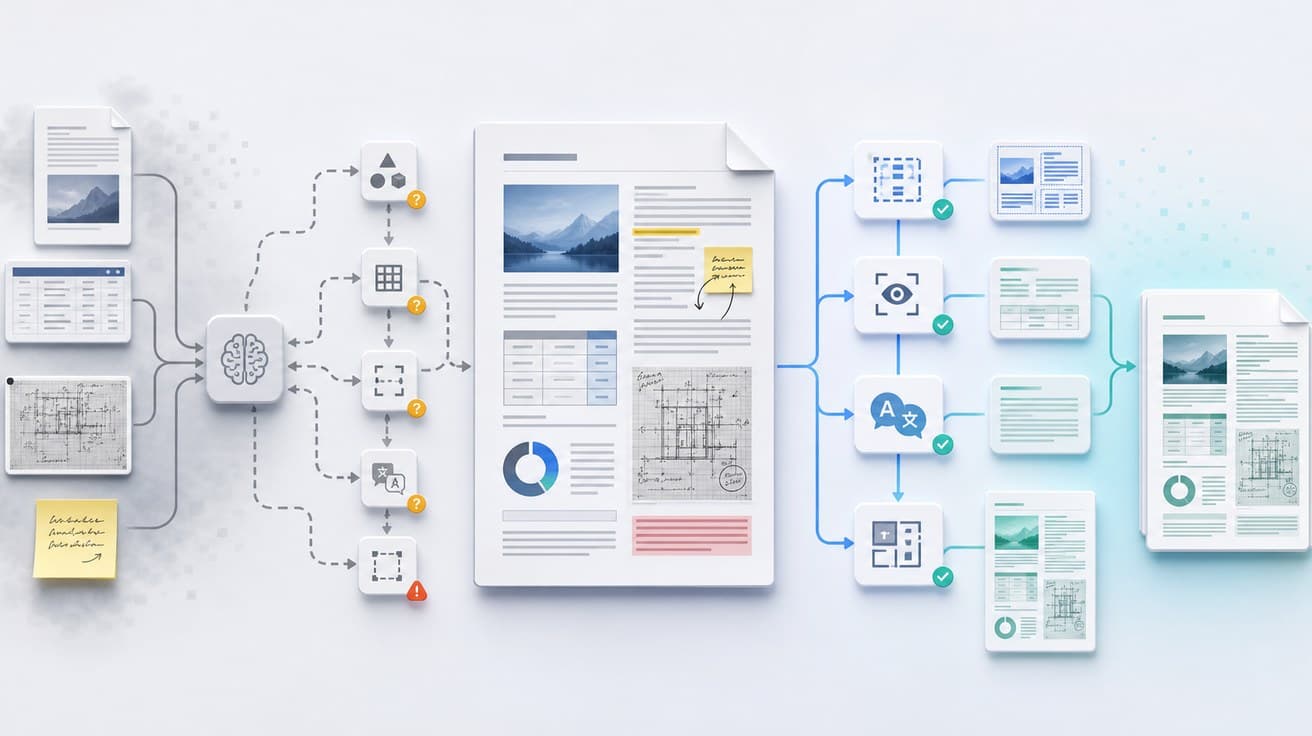
The distinctive structure of academic papers—particularly in the fields of science, engineering, medicine, and the social sciences—presents four major challenges for machine translation:
-
Complex Layout Structures:
- Double/Multiple Column Layouts: The vast majority of journals (such as IEEE, ACM, and Nature) employ double-column formatting. If translation tools are unable to recognize column order, the content of the left and right columns may become intermingled, resulting in disrupted readability.
- Figures and Equations: Academic papers contain a substantial number of figures, tables, and mathematical formulas. Figure captions must be positioned immediately adjacent to their respective figures, and equations must never be erroneously 'translated' or distorted.
- Headers, Footers, and Footnotes: These elements (such as journal names, page numbers, and notes), if mistakenly inserted into the main body of the text, can significantly hinder readability.
-
Highly specialized terminology (Specialized Terminology):
- Consistency: A core term (e.g., "Generative Adversarial Networks") must be rendered identically throughout the paper (e.g., as “生成对抗网络”), not inconsistently as A at times and B at others.
- Contextual Ambiguity: Many words possess entirely different meanings in everyday versus specialized contexts (e.g., "field" may refer to “字段” or “场”).
-
参考文献 (References):
- The bibliography at the end of the paper contains numerous proper nouns (such as author names and journal titles) that should not be translated. Incorrect translations (such as rendering the author 'Smith' as 'Shi Mi Si') are unacceptable.
-
扫描版 PDF (Scanned PDFs):
- Many older or archived papers exist in image format, necessitating translation tools with high-quality OCR (Optical Character Recognition) capabilities.
Academic Paper Translation: In-depth Comparison of Three Tools
Based on the aforementioned pain points, we conducted practical tests of Google Translate, DeepL, and ShangYi AI in processing academic papers.
| Comparison Criteria | Google Translate | DeepL Translator | 商译 AI(ShangYi AI) |
|---|---|---|---|
| Format Retention (Double Columns/Tables and Figures) | ⭐ (Almost Zero) Catastrophic. Completely disregards the original layout, forcibly converting two-column PDFs into a single continuous text. Figures, tables, formulas, and footnotes are either lost or merged into the main content. | ⭐⭐⭐ (Average) The free version demonstrates weak ability to retain formatting. The Pro version shows some improvement, yet still frequently makes errors when processing two-column layouts and figures. Figure captions are often misaligned with the main text. | ⭐⭐⭐⭐⭐ (High) This represents its core strength. It accurately recognizes two-column formatting and translates in the correct sequence. The placement of figures and formulas is well preserved, rendering a reading experience closest to the original. |
| Terminological Accuracy and Consistency | ⭐⭐ (Poor) General translation quality, with imprecise and inconsistent use of specialized terminology. Lacks terminology management functionality. | ⭐⭐⭐⭐ (Good) High-quality text translation, with relatively accurate terminology. However, it lacks the capability for customizing terminology databases, which precludes the guarantee of consistent translation for specific terms. | ⭐⭐⭐⭐⭐ (Excellent) Relies on large language models such as DeepSeek and Gemini, ensuring high terminological accuracy. A key advantage is support for customized terminology databases, which ensures that core academic concepts remain consistent throughout the paper. |
| Processing of long and complex sentences | ⭐⭐⭐ (Fair) Sentence structures are easily disrupted, resulting in awkward translations with poor logical coherence. | ⭐⭐⭐⭐⭐ (Excellent) Text fluency and the processing of long and complex sentences are strengths of DeepL; the translations are highly readable and closely resemble human expression. | ⭐⭐⭐⭐⭐ (Excellent) The DeepSeek and Gemini models excel at understanding complex logic and context, and are capable of accurately processing rigorous academic long sentences. |
| Scanned document (OCR) support | ❌ (Unsupported) Unable to process any scanned or image-based PDFs. | ✅ (Pro Version Supported) The Pro version offers OCR functionality with acceptable quality, though its recognition rate is generally average for low-resolution scans. | ✅ (Supported) Supports OCR, can process scanned PDFs, and achieves a high recognition rate. |
| Reference Handling | ⭐ (Poor) Tends to erroneously translate author names, journal titles, and similar elements in references into the target language. | ⭐⭐⭐ (Fair) Most of the time, it can recognize references and retain the original text, though occasional errors still occur. | ⭐⭐⭐⭐ (Good) Capable of accurately identifying reference sections and preserving their original language (e.g., English author and journal names) without translation. |
Analysis and Conclusion
1. Google Translate
- Academic use: Not suitable (Unsuitable).
- Analysis: When processing PDFs, Google Translate adopts the strategy of 'extracting plain text' rather than 'retaining formatting'. This results in a complete disruption of the paper's layout structure, misalignment between figures and text, and confusion of dual-column content, thereby fundamentally diminishing its value as an academic reading tool.
- Optimal scenario: Applicable only for copying paper abstracts or small amounts of plain-text paragraphs, in order to quickly and freely obtain the general idea of an article.
2. DeepL Translator
- Academic use: Assisted reading (Good for Text Fluency).
- Analysis: DeepL's core strength lies in its top-tier text translation quality. It excels at handling complex academic sentences, yielding translations that are fluent and natural. However, its main drawback is format retention. While superior to Google, it still struggles with complex double-column layouts and figures, with misalignment and overlapping occurring frequently.
- Optimal Scenario: Suitable for users with exceptionally high requirements for the accuracy, fidelity, and elegance of translations. However, during use, you will most likely require dual-screen operation: one screen displaying the text translated by DeepL, and the other referencing the charts and formulas in the original PDF. This results in a fragmented reading experience.
3. ShangYi AI (ShangYi AI)
- Academic Use: Immersive Reading (Ideal for Layout-Critical Reading).
- Analysis: The design of ShangYi AI clearly prioritizes the resolution of the most significant pain point—format retention. In testing, it is able to highly restore the original layout of the paper, particularly with respect to double columns and the placement of figures and tables, thereby achieving a genuine WYSIWYG reading experience. Its Glossary feature is another specialized function tailored for academic research, addressing the core need for consistency in term translation. Additionally, it supports the direct input of arXiv paper URLs for translation, which greatly facilitates researchers who need to track the latest preprints.
- Optimal Scenario: Suitable for users who require thorough reading and critical analysis of research papers. It removes the inconvenience of repeatedly switching between the translation and the original text or cross-referencing figures, thereby maximizing the immersive reading experience.
Summary
With regard to academic paper translation, the value of a tool lies not only in its translation engine (such as DeepL, DeepSeek, or Gemini), but more importantly in its ability to analyze PDF document structures.
- Google Translate is essentially disqualified in this comparison because it disregards formatting.
- DeepL offers the best text translation, but at the cost of document integrity.
- ShangYi AI provides an optimal balance between translation quality and format retention. Its specialized features—such as a terminology database and arXiv link translation—also make it more closely aligned with researchers' actual workflows.
Therefore, the choice of tool depends on your primary requirements: whether you merely need to translate text, or require access to a fully formatted document.