Abstract
Traditional machine translation (Machine Translation) systems have made significant contributions to improving the efficiency of cross-linguistic communication; however, they often appear rigid when addressing context, pragmatics, and subtle cultural nuances. The advent of generative pre-trained models, represented by GPT (Generative Pre-trained Transformer), is fundamentally transforming the field of translation. This paper will conduct a thorough analysis of GPT’s principal advantages in contextual awareness, stylistic adaptation, bias mitigation, and dynamic adaptation to new corpora, explicating why it enables a paradigm shift from 'literal translation' to 'deep understanding.'
How GPT is Reshaping the Paradigm of Translation: From Contextual Awareness to Stylistic Evolution
For an extended period, despite continual advancements in the efficiency of traditional machine translation, there has remained a pronounced disparity between the fluency, accuracy, and cultural alignment of machine-rendered texts and the standards of 'faithfulness, expressiveness, and elegance' (信达雅) upheld in professional human translation. The perceptible 'mechanical quality' of machine-generated translations and their misjudgment of complex contexts constitute primary pain points in user experience.
However, the rapid emergence of GPT technology marks a profound transformation in the translation paradigm. Translation is no longer confined to simple lexical substitution or rule-based matching; rather, it now manifests an ability to comprehend the deep structure of language. By what mechanisms has GPT achieved such a breakthrough in translation quality?
Beyond Literal Meaning: Deep Contextual Awareness
The essence of high-quality translation lies in the precise apprehension of context. Traditional models are frequently constrained by limited window sizes, impeding their capacity to capture long-distance semantic dependencies.
Consider the following example:
I didn’t see her face because of the mask.
A model lacking robust world knowledge and contextual inference capabilities may fail to distinguish whether 'mask' in the current context refers to a masquerade accessory from decades past or to the widely used medical mask of recent years, thus leading to translational inaccuracies.
The principal advantage of GPT resides in its extensive training data, which encompasses a wide array of real-world contexts. It is capable of analyzing context to determine the most probable meaning of 'mask' in contemporary public health discourse, thereby producing translations that more accurately reflect actual situational usage.
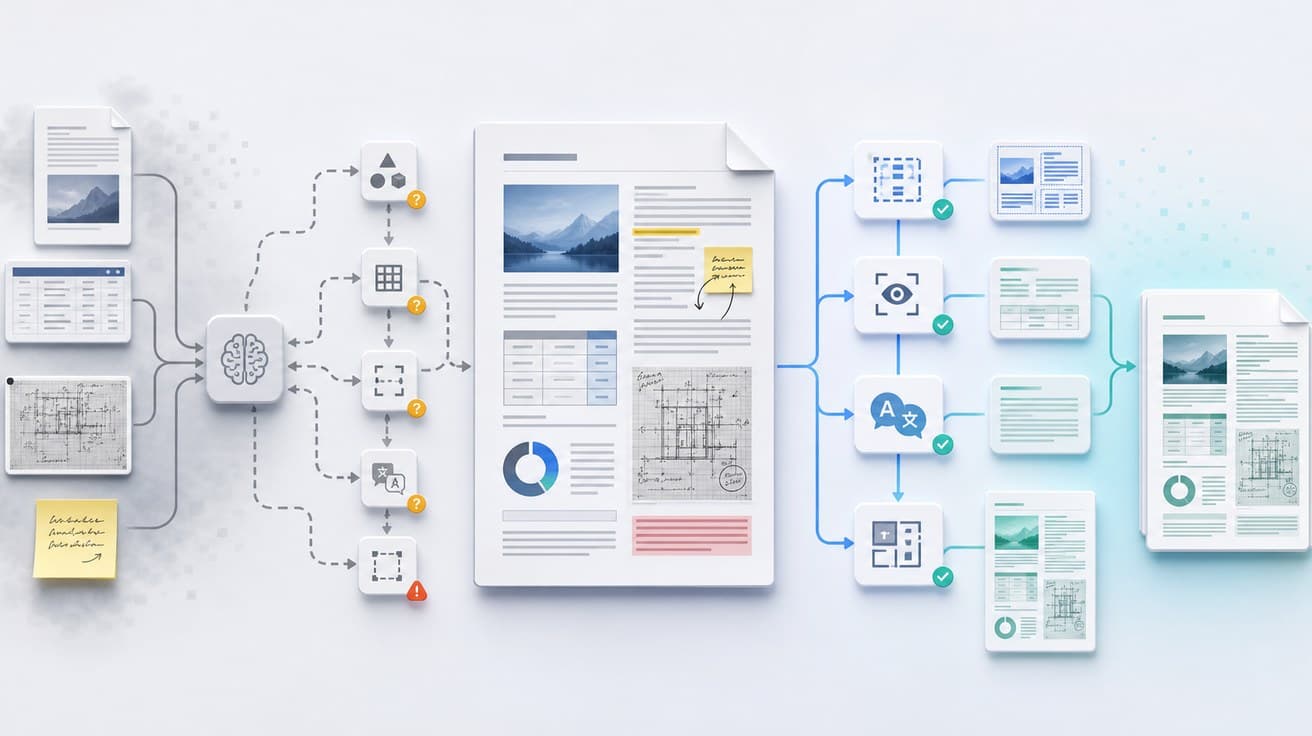
Such deep contextual understanding is essential for the translation of specialized documents. When handling legal contracts, technical manuals, or academic articles, ambiguity in terminology and indeterminate anaphoric references constitute critical weaknesses that undermine translation quality. GPT is able to more effectively identify logical chains within lengthy documents, thereby ensuring the coherence and professionalism of the translation. Advanced AI translation solutions, such as Shangyi AI, now enable high-fidelity PDF document translation with precise reproduction of the original formatting, thereby fully capitalizing on this technological advantage.
Moving Beyond 'Translationese': Achieving Fluent and Authentic Language Styles
Traditional machine translation has frequently been criticized for rigid syntactic structures and inauthentic expressions—phenomena commonly labeled as 'translationese'. Recent advancements in GPT-based language generation enable the production of natural text that more accurately reflects the conventions of the target language.
We take a complex sentence as a comparative example:
- Original sentence: “Although he was tired after working long hours, he still decided to go to the gym, which his doctor had advised him to do for improving his health.”
- Traditional MT: “Although he was tired after working long hours, he still decided to go to the gym, which was what the doctor advised him to do to improve his health.” (The sentence structure is redundant, and the logic is somewhat awkward.)
- GPT Optimization: “Although working overtime left him exhausted, he still decided to go to the gym, as this was, after all, the recommendation his doctor gave to improve his health.” (The word order is fluent, the lexicon is idiomatic, and it better aligns with the conventions of Chinese expression.)
Through its advanced generative capabilities, GPT is able to proactively restructure syntactic patterns, select more precise lexical items, and introduce necessary connectives to enhance textual coherence, thereby freeing translations from the rigidity of literalism and realizing authentic fluency and naturalness.
Mitigating Implicit Bias: Constructing More Neutral Language Models
Language functions as a vehicle for culture, and it inevitably reflects algorithmic bias inherent in society. For instance, traditional translation models, when handling occupational terms such as 'doctor' or 'engineer,' may have a tendency to default to masculine pronouns.
Owing to broader, more diverse training data and ongoing algorithmic optimization, the latest generation of GPT models demonstrates greater neutrality in addressing such problems. These models are better equipped to detect and avoid stereotypes related to gender, race, or other social attributes, thereby delivering more objective and equitable translation results. This constitutes a significant technological advance in fostering social inclusivity.
Capturing Dynamic Corpora: Real-Time Tracking of Slang and Neologisms
Language is dynamic and continually evolving; slang, internet neologisms, and industry-specific jargon constantly emerge. This presents a major challenge for traditional translation models that rely on static corpora.
The cornerstone of GPT’s training lies in its vast and continually updated corpus of internet texts, which confers upon it exceptional dynamic linguistic data capture capability. Whether addressing contemporary internet vernacular or specialized terminology within specific communities, GPT exhibits markedly enhanced comprehension and translation proficiency.
For enterprises undertaking global marketing or individuals seeking to understand the latest discursive paradigms across diverse cultural contexts, this real-time adaptability is critically important. In domains such as professional manga translation, which entail a significant proportion of subcultural vocabulary, the advantages of GPT are especially evident.
Continuous Iteration: Prospects for the Future of Translation Models
GPT's principal advantage resides in its architecture-driven capacity for continual learning and evolution.
In contrast to Statistical Machine Translation (SMT), which depends on predefined rules, GPT models built upon the Transformer architecture—as exemplified by the suite of models released by OpenAI—can continuously optimize their translation performance through ongoing training and fine-tuning.
Accordingly, GPT does not merely serve as a replacement for traditional machine translation, but rather constitutes a fundamental 'evolutionary entity' that is redefining standards for cross-linguistic communication.
Professional-grade translation platforms such as Shangyi AI (商译 AI) (website: https://shangyiai.com/) are built on such advanced models and are dedicated to delivering precise, fluent, and highly intelligent document and text translation services for both enterprise and individual users. This marks the advent of a new era of AI-driven barrier-free communication.